I build websites and AI automation for small businesses, so a good part of my week goes on finding out why something does not behave the way I expected. That work is mostly reading, guessing, testing, and being proved wrong until the guess holds. Better tools make that loop cheaper. The interesting problem is the moment it stops moving entirely.
I have a rule now that came out of a bug that took months to close, and it has changed the way I choose which model to ask. It is about changing the family of the model rather than rewording the question.
Why a better prompt rarely helps
When I get stuck, my instinct is to explain the problem more carefully. I add context, restate the symptom, list what I have already ruled out. It feels like progress because the answer comes back sharper and better organised. The reasoning underneath is usually the same reasoning, and it arrives in different words.
The model has found a groove, a way of reading the symptom that fits its training, and every new phrasing leads back into that groove. I spent months on a user-space Linux bug with Claude Opus and kept getting careful, plausible explanations that pointed at the same places. Rewording the prompt gave me the same diagnosis with better prose.
Two failed attempts is where I now stop trusting my own framing. Pushing a third prompt into the same conversation usually produces a fourth version of the first answer.
Switch family, not wording
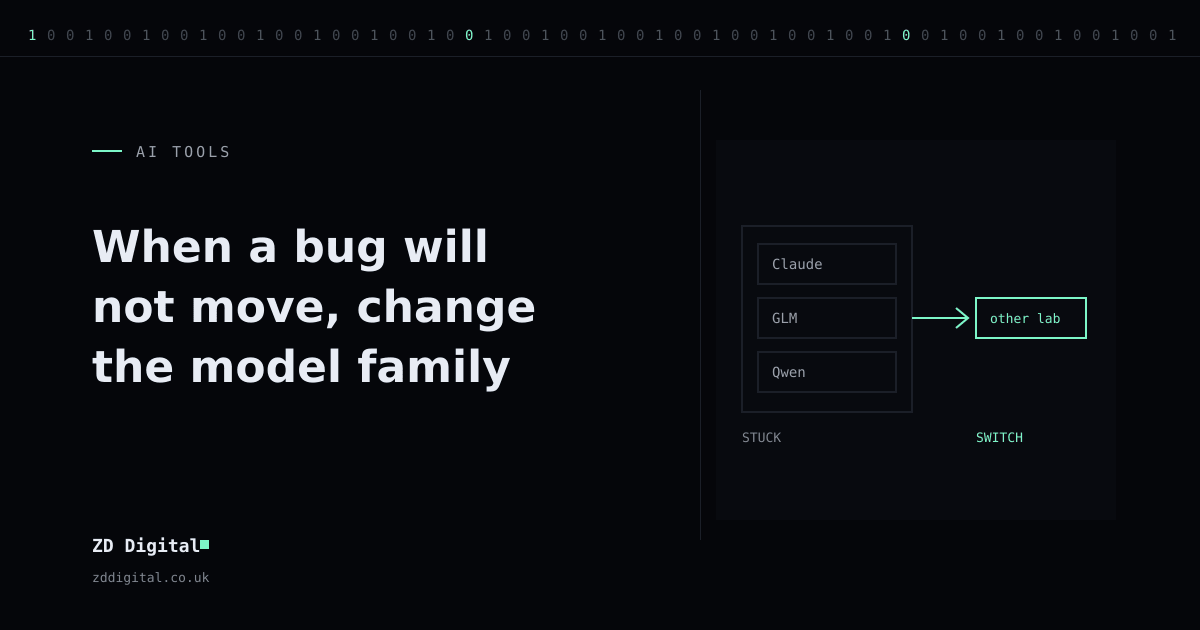
Models from different labs are trained on different data and tuned differently, so they get stuck in different places. The underlying designs are broadly similar, and the difference that matters in practice is mostly training. A model that has never seen your thread has no reason to inherit its assumptions.
The Linux bug is the clearest example I have. Gemini 4 Argon found it, and it found it by reading and tracing the source of the failing component. Along the way, the models I was using kept circling a recent kernel update as the likely cause. That was a red herring.
I should be honest about how the families feel to me, because this is an impression rather than a finding. GLM and Qwen think a lot like Claude, and DeepSeek sits somewhere between ChatGPT and Claude. Switching between models that behave like Claude is a smaller change than it looks, so a genuine second opinion often means leaving that group entirely.
Keep a router in your back pocket
The practical obstacle used to be friction. Each lab meant another account, another key, another bill, and by the time I had signed up the momentum was gone. OpenRouter removes most of that. It is a router, so one account and one API key give access to models from many labs, and changing family takes seconds instead of an afternoon.
I keep it configured even in weeks when I barely use it, the same way I keep a spare drill bit. The value is that the switch is available at the moment I need it. When a problem has already eaten my day, skipping the setup decides whether the second opinion happens at all.
Delegated reviewers for when you are really stuck
My rule is simple. After two failed fix-and-check attempts on the same problem, I stop and ask a model from a different lab for a second reading before I try a third time. The reviewer gets a fresh context: the symptom, the relevant code, what I have ruled out. It does not get my running theory, because a reviewer handed my theory will tend to agree with it.
I treat the answer as evidence rather than a verdict. Sometimes it names the cause and I can check it in minutes. Sometimes it points at something adjacent, which is enough to break the groove even when it is not the answer.
The same habit works before a large change. A different model reviewing the plan will catch things the author's model will not, partly because it has no stake in the design and partly because it reads the plan the way a stranger would.
What this means for a small business
For a studio my size, this is the closest thing to hiring a second engineer without the salary. I can put a problem in front of several labs in an afternoon and pay only for the tokens I use. The cost of a second reading is small next to the cost of a week spent on the wrong theory.
It also keeps me honest with clients. When I say a fix is checked, I mean I have looked at it from more than one direction. The tools do not make the judgement for me, and I would not want them to. They make it cheaper to be wrong early, which is the part that actually matters.