Spend any time in UK small business and you notice the gap. The software exists, the pricing is not the obstacle, and the owners are not luddites. They are mostly not using it for much beyond drafting the occasional email. The ONS Business Insights survey tracks AI use by business size, and the pattern it shows is the one you would expect: adoption falls sharply as headcount does.
The usual explanation is caution, or a skills shortage, or British conservatism. We think those are symptoms. The cause is simpler and more annoying: almost nothing in the market is designed for a business this size.
The tooling is built for two audiences, and you are neither
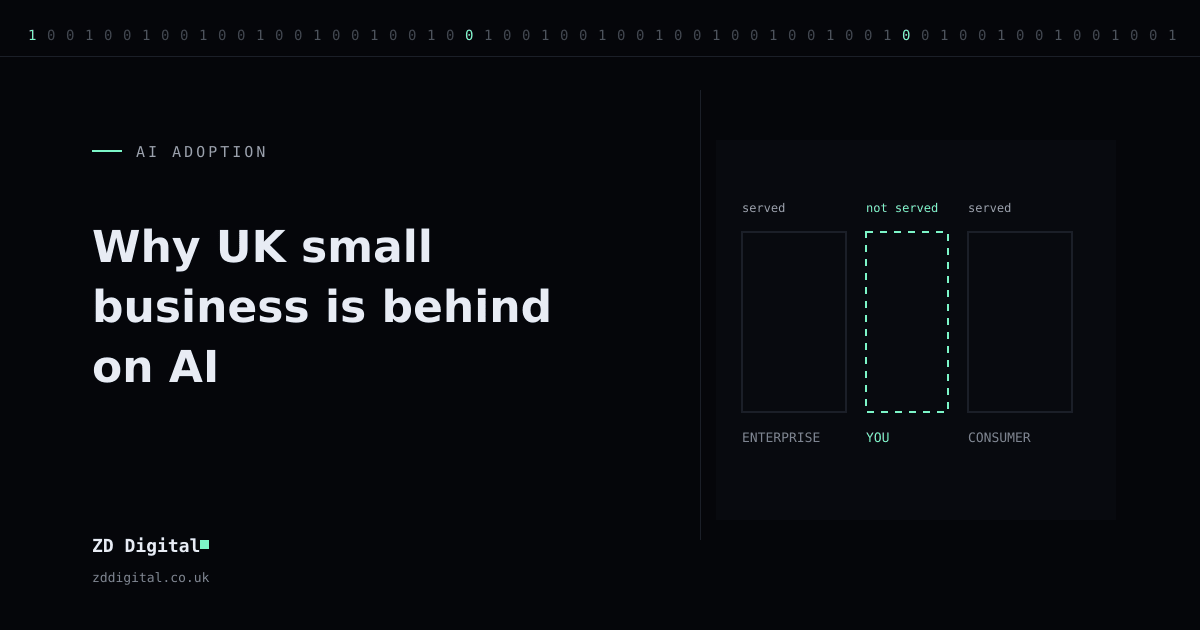
Look at who AI products are actually sold to. At one end, enterprise: procurement cycles, security questionnaires, a platform team to integrate it, a budget line. At the other, individual consumers: a subscription, a chat box, use it however you like.
A firm with nine people and no IT department falls between. Too small to absorb an enterprise rollout, too structured to get value from a chat box that knows nothing about how the business works. The enterprise tools assume staff you do not have. The consumer tools assume you will work out the integration yourself, which means it will not happen, because the person who would do it is also doing payroll.
The advice problem
The second obstacle is who is giving the advice. A small business owner researching this is served mostly by two groups: vendors selling a specific product, and consultants selling a transformation programme. Neither is incentivised to say the most useful true thing, which is often "for your business, this one job is worth automating and the rest is not".
What is missing is unglamorous and specific: a list of the three things in this particular business that are repetitive, rule-based and low risk, and a plan for those.
The regulatory fog is real but overstated
Data protection comes up in every conversation, usually as a reason not to start. The concern is legitimate, and more often justified than the optimistic version of this article would admit.
Sorting an inbox, drafting from a document, reading an invoice: each of those is processing personal data the moment the content reaches a model run by somebody else. That does not put them off limits. It makes them things you do with a processor agreement in place, with retention terms you have actually read, and with a clear answer to who can see the data. The ICO publishes guidance specifically on AI and data protection, and it is more readable than most people expect.
What "behind" actually costs
It is worth being honest that being behind on AI is not automatically expensive. Plenty of businesses that ignored the last three technology waves are fine. The cost shows up in a narrower place: in the specific jobs where a competitor has removed an hour a day and you have not, compounding quietly over a year.
The firms pulling ahead are not the ones with an AI strategy. They are the ones who picked two or three jobs nobody enjoys and stopped doing them by hand.
Where to start, if you want to
- Write down the jobs someone in your business does every week that follow the same steps every time. That list is the whole opportunity.
- Pick the one where being wrong is cheapest, and start there rather than with the one where the saving is biggest.
- Put a person between the automation and anything that reaches a client, and between it and anything that writes to your records. Drafting is the safe part. Sending and saving are not.
- Ignore anything sold as transformation. Three jobs is the right size of ambition to start with.
UK small businesses are not slow to adopt because they are timid. They are slow because the market has not built for them, and because most of the available advice is written by people selling something else. I should be plain that I am one of those people: I sell exactly the work this article recommends. The way to hold me to it is to ask which jobs I think are not worth automating, and to expect a specific answer.
Related reading: the end of the cheaper token, and whether SEO still matters now assistants answer first. Our automation and AI workflows page covers how we scope this, and this project is the three-jobs approach applied to a real team.