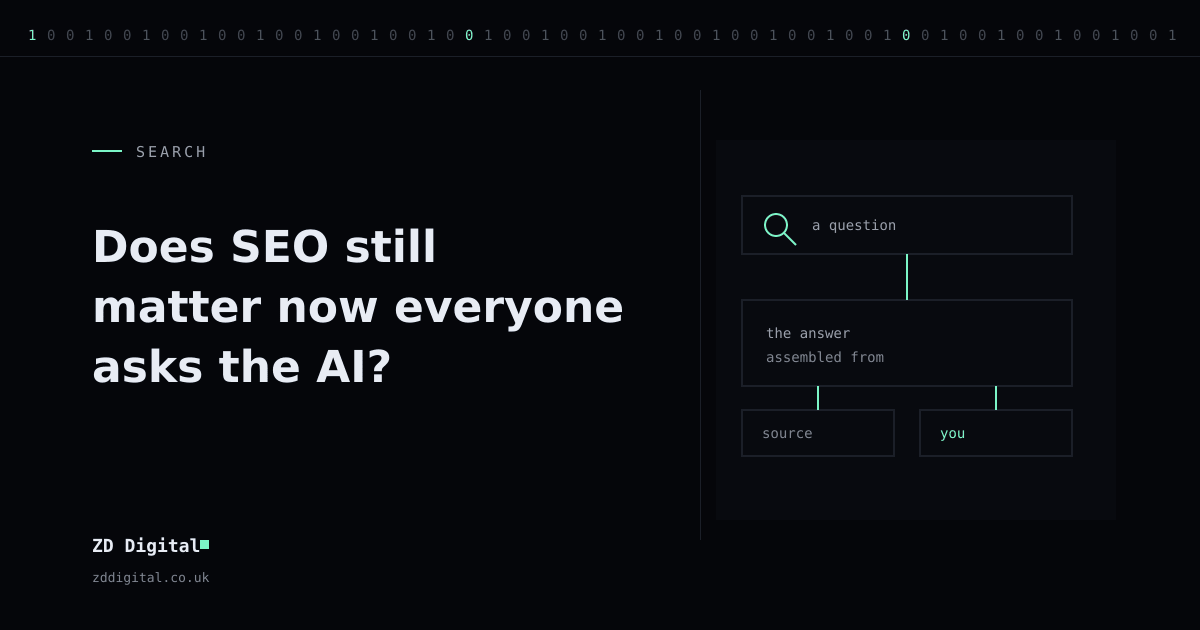
Every few months someone announces the death of SEO, and every few months the people who stopped doing it quietly start again. This time the argument is better than usual, so it is worth taking seriously rather than waving away.
The argument goes: people no longer type a query and pick from ten blue links. They ask an assistant, get an answer, and never visit anyone's website. If nobody arrives, what exactly is the traffic you were optimising for?
What actually changed
The honest answer is that the first reader of your page is now often a machine, and it is reading on behalf of someone who will never see your layout, your hero image or your carefully placed call to action. It extracts an answer and presents it in its own voice.
That is a real change, and it does hurt one specific kind of page badly: the thin informational article written purely to catch a question. If your page existed to answer "what is the VAT threshold" in four hundred words of padding, an assistant now does that better, faster, and without the cookie banner.
What it does not touch is the reason anyone would pick you. An assistant can tell someone what the VAT threshold is. It cannot tell them whether you are the right accountant for a business that just crossed it.
Being the source is the new being first
When an assistant answers from the live web, it is reading something, and those sources are pages someone wrote and published. Being one of them overlaps almost entirely with what SEO already asked for. Not every answer works that way: plenty come from what the model already absorbed in training, where there is no page to be and no citation to win. The work below only helps with the first kind.
The one genuinely new job is checking what the assistants currently say about you, and about your sector, and noticing when they are wrong. Google publishes its own guidance on helpful content, and most of it reads as advice for this world rather than the last one.
The traffic that still arrives is better
There may be an upside, and it is worth stating as a hypothesis rather than a consolation. If an assistant handles the people who only wanted a definition, the ones who still click through wanted more than that. Whether they convert better is a question your own numbers can answer and this article cannot. It is equally possible you have lost people who would have become customers in a year.
Whether that trade is good or bad for you depends on whether those pages were earning anything in the first place. In the sites I am asked to look at, the answer is usually no: the blog existed because someone said you should have a blog. Your analytics will tell you which case you are in, and it is worth checking before deciding this is good news.
What we would actually do
If you are asking whether to keep investing, the questions worth answering are narrow ones.
- Which of your pages exist to catch a question a machine now answers better? Those are the ones at risk, and there are usually fewer of them than feared.
- What do the assistants say when asked about your sector, and are you in the answer at all?
- Is your site readable by a machine that never sees it rendered? Structure, markup and a crawlable catalogue still decide this. Schema.org is still the vocabulary for saying what a page is.
- What can you say that nobody else in your market can? That was always the actual job.
SEO stopped being about beating a ranking algorithm some time ago. It is about being the thing that gets quoted, whether the quoting is done by a search engine, an assistant, or a person forwarding your page to a colleague. The mechanism has changed more than the work has.
If you want the adjacent argument, we wrote about why UK small businesses are behind on AI and about what happens when the cost of a model call stops falling. Our LLM optimisation page covers the testing side, and the things we have built shows what this looks like when it becomes software.