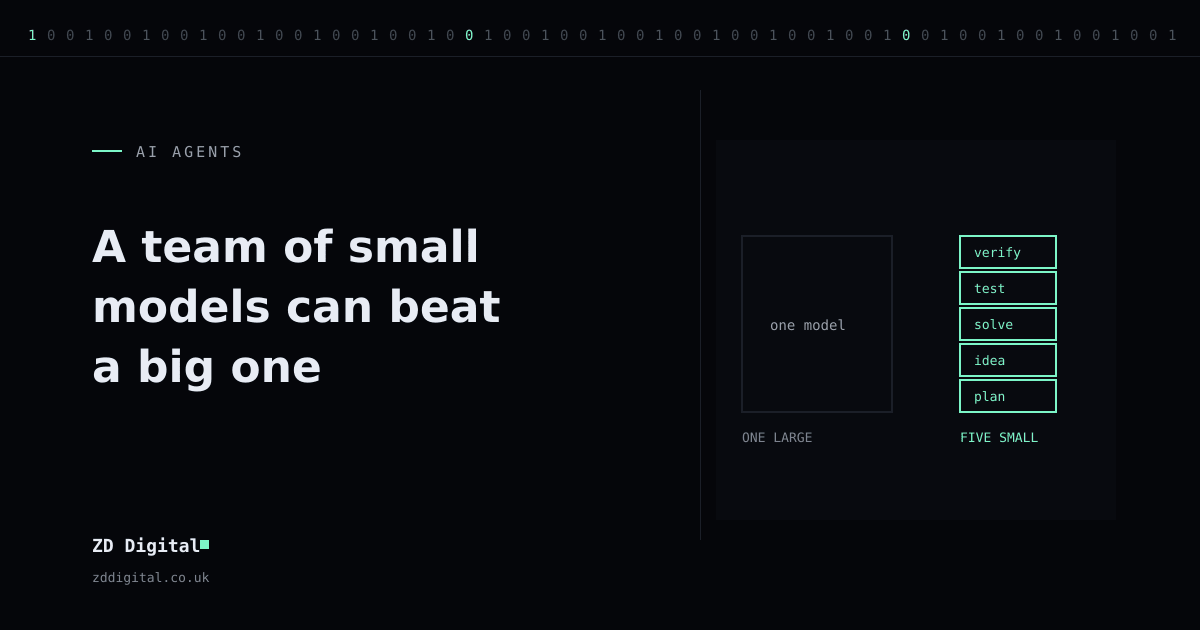
Five boys stand on each other's shoulders, together as tall as the gorilla beside them. That drawing opens the repository for GVS5H (Gorilla vs. 5 Humans), a paper by Lee published this year by Persis Capital's research lab. Its claim is narrow: a group of ordinary models, organised properly, can match one very clever model.
For most of this year the answer to every AI problem has been a bigger model. Buy more tokens, wait for the next release, assume the smartest single system wins. This paper is concrete evidence for something anyone who has run a team already knows.
What the result actually is
The method is training-free. Fresh instances of one model split a problem into pieces and coordinate through a shared filesystem holding a plan, notes and the current solution. No fine-tuning, just files on disk and a division of labour. The paper is on arXiv.
Eleven models were tested on the 100 latest hard LiveCodeBench problems, a coding benchmark built from recent contest questions. Open-weight Qwen3.8-27B scored 66.8% alone. Organised this way it scored 92.4%. Claude Fable 5 answering in a single call scored 90.4%. Qwen3.8-27B can be self-hosted.
What makes us trust this is that someone else rebuilt it. The Memdoor project's open workflow, team-solve, uses a planner, two ideators, a solver, a manager and a repair worker. Each starts from a fresh context and they talk only through files on disk. A plain script runs the program against sample tests and decides success. The two ideators deliberately propose approaches from different families.
Their reproduction is small: ten problems, five passes. They score 9.8 out of 10 against the authors' harness at 9.6, and say plainly that on a sample this small those are the same number. Nobody there is claiming a gain. That honesty is worth more than a bigger number would have been.
Why a team of average models works
No member of this team out-thinks the model it beats. Structure is what they have.
- Each starts fresh. One model holding a problem for a long time starts believing its own early mistakes, and every later step inherits them. New instances carry none of that baggage.
- They write things down. The paper's own transcript analysis attributes the gain to decomposition and persistent context. Split the job, keep a ledger.
- Something that is not a model decides. In the Memdoor rebuild a plain script runs the sample tests and judges success. The judge has no opinion and no reason to be kind.
This is how real teams win
A good kitchen on a busy Saturday does not depend on one brilliant cook. It depends on sections, a pass, and someone calling orders. A hospital ward runs on handover notes and checklists, because the person coming on shift needs to know what happened without asking the person going home. An accounts team at year end works to a timetable and a reconciliation that does not care who did the bookkeeping.
In each case the people are competent rather than exceptional. The system is what makes the output reliable: handover notes, checklists, a second pair of eyes, a check that ignores seniority.
Francis Galton wrote about this in 1907. The middle guess of a fairground crowd at an ox's weight landed very close to the true weight, closer than most individuals managed. A crowd is wise because its errors differ and something combines them. The two ideators in team-solve do this on purpose.
Where it breaks
It does not always work. In Memdoor's runs the one lost problem came from the manager inventing a wrong counterexample, after which the team rewrote a program that was already correct. Every office has sat through that meeting.
Some models were unchanged or worse with the same setup, so the structure is not a universal multiplier. The contests date from 2025, which means they may be in the training data. Contamination cannot be ruled out for any of those scores.
So more agents do not always win. A team with clear roles, a written record and an honest test beats one clever agent marking its own homework. It loses when the structure lets a confident voice overrule the evidence.
What it means for a small business
Most small businesses do not need the most expensive model. They need the job split into steps a cheaper model does reliably, with a final check that is not another model's opinion. With AI costs turning flat rather than falling, that arrangement gets more valuable, not less.
Privacy is the other half. Open-weight models can run on a machine you own, so client data stays in the building. For a firm handling other people's books, that is not a detail.
It also fits how a nine-person business already runs. You do not hire one genius and hope. You hire decent people, write things down, check the work. We wrote recently about why UK small business is behind on AI, and the gap looks closeable from here. If you want to see the things we have built, they are on our projects page.